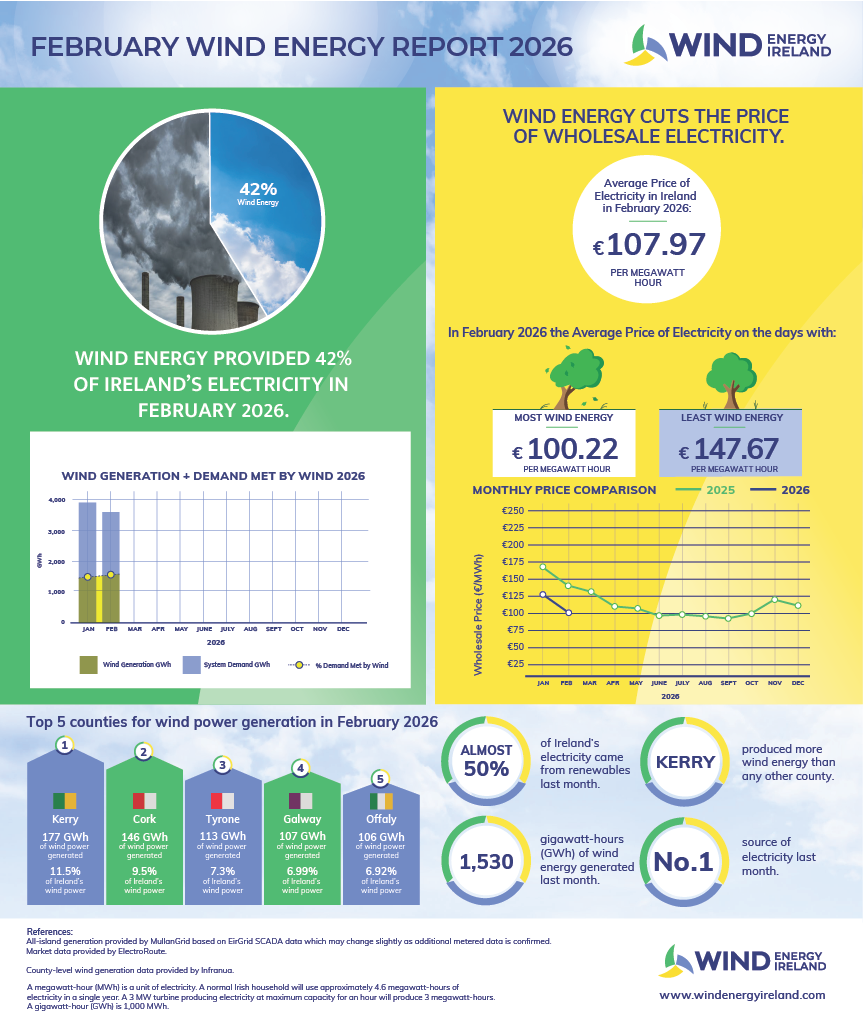
Wind energy provided 42 per cent of Ireland’s power in February, making it Ireland’s leading source of electricity last month. That is according to Wind Energy Ireland, which today published its monthly wind energy report.
Average wholesale electricity prices fell to €107.97 per megawatt-hour, down from €140.85 in February 2025, with wind energy playing a key role in driving down costs. These figures are from before the start of US-Israeli attacks on Iran on 28 February.
On days with the highest levels of wind generation, average wholesale prices dropped to €100.22 per megawatt-hour. By contrast, prices rose to €147.67 on days when the system relied almost entirely on imported fossil fuels.
Noel Cunniffe, CEO of Wind Energy Ireland said: “As we have seen in recent weeks, relying on imported fossil fuels to generate electricity leaves us exposed to price shocks driven by global crises and the ongoing conflict in the Middle East. In the first week of March, wholesale gas prices doubled in just a few days. It is Irish families and businesses who will pay the price for our continued dependence on imported fossil fuels.
“A decarbonised energy system powered by our own energy is not just about climate action, it is about strengthening our energy security, delivering price stability and protecting consumers.
“By building wind farms faster and at the best possible price, we can secure our supply of electricity and transform Ireland into an electrostate powered by clean, affordable, Irish energy.”
County by County generation
The latest figures show that wind power generation in February totalled around 1,530 gigawatt-hours (GWh), with Kerry once again ranking as Ireland’s highest producing county for wind energy (177 GWh). It was followed by Cork (146 GWh), Tyrone (113 GWh) and Galway (107 GWh). Offaly remained among the top five counties, generating around 106 GWh after taking the top spot for the first time in January.
Noel Cunniffe added: “Every month we see just how important wind energy is for Ireland and these latest figures show again the key role it plays in powering the country. Counties like Kerry, Cork, Tyrone, Galway and Offaly are great examples of what we can achieve when we make the most of our natural resources.
“Wind and solar generation saved Ireland more than €1.5 billion in gas costs in 2025, while avoiding over five million tonnes of CO₂ emissions across the island of Ireland.”
“Instead of importing more than one billion euro of gas, Irish wind farms pushed down prices and kept money at home, supporting our economy.”
Addressing grid challenges
As part of Ireland’s upcoming Presidency of the EU Council, WEI is calling on the Irish Government to help advance the EU Grids Package, which includes measures to deliver more efficient planning processes and greater investment certainty for electricity grids.
Noel Cunniffe concluded: “Ireland’s wind resources are world-class but meeting our energy security and climate targets depends on turning ambition into delivery.
“We must ensure wind energy projects are delivered at scale and at pace by addressing barriers in our electricity grid which is increasingly hitting capacity.
“Ireland’s 2026 EU Presidency is a major opportunity to shape Europe’s energy future and progress the EU Grids Package - strengthening the economy, electrifying our industry and securing a reliable supply of clean, affordable, energy for consumers.”
The results of this report are based on EirGrid’s SCADA data compiled by MullanGrid, market data provided by ElectroRoute and county-level wind generation data provided by Infranua.
%20(2)-Mar-12-2026-09-56-18-9741-AM.png?width=352&name=Blog%20Image%20(General)%20(2)-Mar-12-2026-09-56-18-9741-AM.png)