


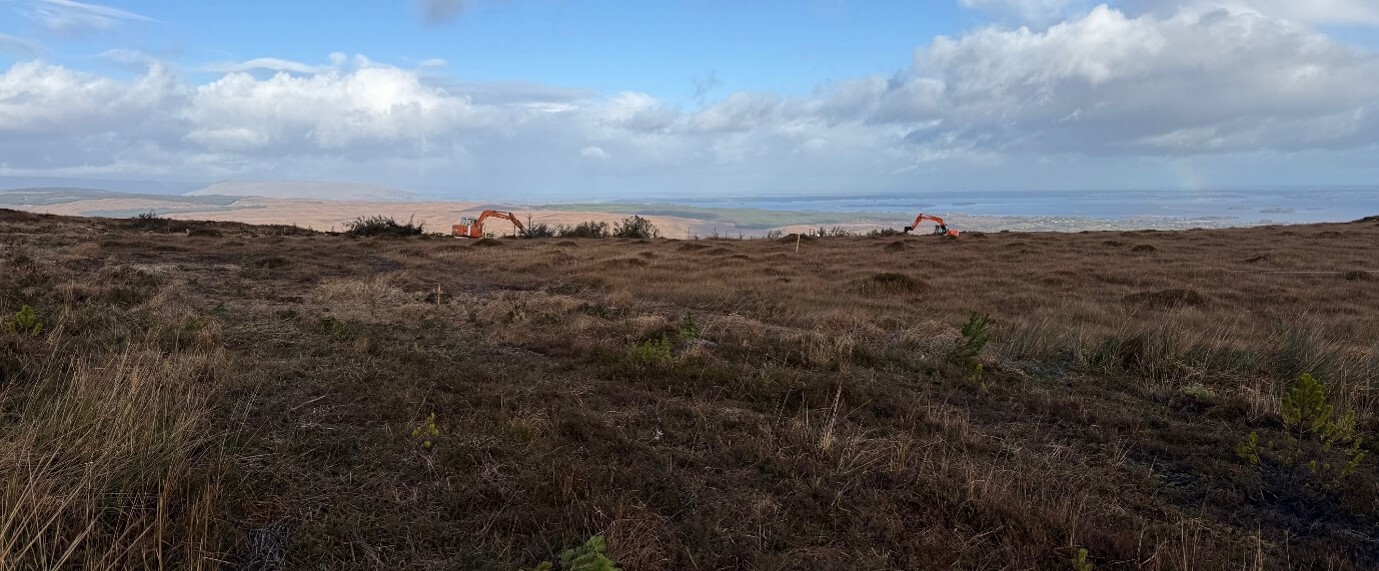
More than 120 hectares of degraded peatland are being restored as part of a major European peatland restoration programme.
Beneath the turbines of Galway Wind Park, a quiet transformation is underway as damaged peatlands are restored and one of Ireland’s rarest habitats begins its journey to recovery. In Ireland, these unique landscapes play a vital role in tackling climate change and supporting biodiversity. They store large amounts of carbon, regulate water, and are home to rare plants and wildlife. When peatlands are damaged or drained, however, they can switch from sequestering and storing carbon to releasing it into the atmosphere. Restoring them is therefore a crucial part of climate action.
At Galway Wind Park, an SSE-Greencoat Renewables joint venture, the SSE Nature Strategy Team have been leading a major habitat management plan for the last four years, part-funded by EU LIFE Multi-Peat and delivered in collaboration with the University of Galway, Forum Connemara CLG and partners across Europe.
This EU‑wide programme is working across Ireland, Poland, Germany, Belgium and the Netherlands to restore degraded peatlands, reduce greenhouse gas emissions and overcome the practical challenges of working in landscapes shared by many landowners and stakeholders. By felling conifers and restoring water levels in damaged peatlands, the project aims to restore the natural conditions that allow peat to form and begin storing carbon again.
Protecting a Rare and Valuable Habitat
Ireland has a particular responsibility when it comes to peatland protection. It is the only EU Member State with a significant share of Atlantic blanket bog; a rare habitat found mainly along the western seaboard. Once covering more than 770,000 hectares, Atlantic blanket bog has declined by over 80 per cent due to centuries of drainage, turf cutting, afforestation and overgrazing. What remains is often fragmented or in poor condition.
The Connemara Bog Complex Special Area of Conservation (SAC) is one of the largest remaining areas of blanket bog in Ireland, covering almost 49,000 hectares. While parts of this landscape enjoy protected status, large areas continue to show the effects of past land use. The restoration work at Galway Wind Park focuses on degraded peatland which will connect the Connemara Box Complex SAC to the Oughterard Bog District National Heritage Area (NHA) and also increase an important wintering habitat for the Greenland white‑fronted goose, a species of national conservation importance, making restoration work especially valuable for biodiversity. Alongside ecological benefits, the project is also exploring how repairing peatlands within a wind farm can complement renewable energy generation by reducing emissions from degraded peat while producing clean electricity.
From Planning to Restoration
Before restoration began, extensive planning and assessment were required. Specialist ecologists prepared a detailed restoration plan setting out how trees would be removed, drainage channels blocked to raise the water table level, and all with careful consideration for nearby habitats and watercourses. Advanced topography mapping using LiDAR technology was used to create a highly detailed picture of the site’s drainage network. This allowed the project team to plan exactly where drainage dams should be installed and what type would be most suitable in each location.
Most drains were blocked using peat within the drains themselves, a method that blends naturally into the habitat. Required planning permissions from Galway County Council were granted in summer 2025, allowing restoration works to begin on site in September 2025. Tree felling and drain blocking has since been completed across just under 50% of the site.
Monitoring Progress and Building Evidence
Monitoring is a vital component of the project. Greenhouse gas emissions are being measured monthly alongside changes in peatland ground water levels, helping researchers understand how restoration affects peatland behaviour over time. In December 2025, innovative sensor technology was installed across the site during challenging winter conditions. These small, low‑impact sensors transmit daily data on water levels and temperature directly from the peat soils to remote dashboards via satellite, reducing the need for frequent site visits.
The data collected at Galway Wind Park will be used as scientific evidence underpinning future peatland restoration and greenhouse gas modelling. It will also support long‑term habitat management plans, guide future policy and help identify opportunities to expand protected peatland areas.
Ultimately, this work goes beyond restoring one site. By collaborating with local landowners, farmers, conservation groups and research partners, the project aims to support peatland restoration at a wider landscape scale. Galway Wind Park demonstrates how climate action, biodiversity protection and renewable energy can work hand in hand — and how damaged peatlands can be set on a path to long‑term recovery.

%20(54).png?width=352&name=Blog%20Image%20(General)%20(54).png)
%20(4)-Nov-14-2025-10-03-16-8756-AM.png?width=352&name=Blog%20Image%20(General)%20(4)-Nov-14-2025-10-03-16-8756-AM.png)