



04 February 2026
Onshore wind capacity exceeds 5,000MW, driving Ireland’s transition to an energy independent electrostate powered by clean, affordable, Irish energy.
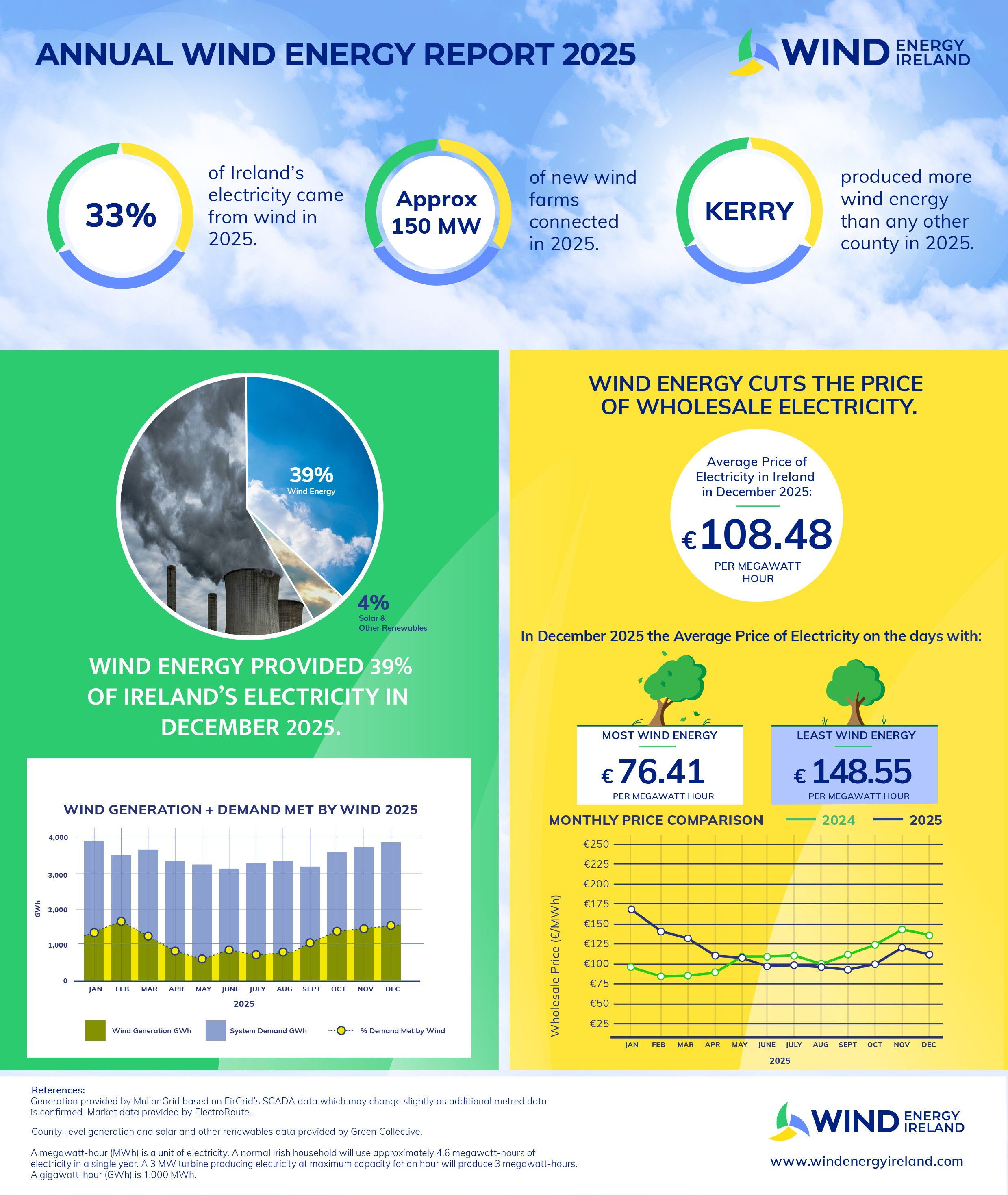
Irish wind farms provided a third of the island of Ireland’s electricity in 2025. That is according to Wind Energy Ireland, which today published its annual wind energy report.
The latest figures show that the Republic of Ireland now has more than 5,000 MW of installed onshore wind capacity, with 150 MW added last year, highlighting the country’s potential to build an energy system powered by more clean, affordable energy.
Wind farms delivered around 13,634 GWh of clean electricity last year, with Kerry leading the country as the top-producing county for wind power, followed by Cork and Galway.
In December alone wind farms provided 39 per cent of our power and helped push wholesale electricity prices down from €136.99 in December 2024 to €108.48 last month.
Noel Cunniffe, CEO of Wind Energy Ireland, said: “Our members can be proud of the role Irish wind farms played last year in supporting electricity consumers and reducing our carbon emissions.
“Ireland now has over 5,000 MW of onshore wind energy with a further 450MW in construction and 2,500 MW of projects with planning permission.
“By building more wind farms, strengthening our electricity grid, adding more storage and electrifying our economy, we can build an Irish electrostate where secure, clean, affordable power creates new opportunities right across the economy.”
Grid challenges
However, growth in wind energy is made more challenging by increasing levels of ‘dispatch-down’, where wind farms are instructed to reduce the amount of power they produce because the electricity grid is not strong enough.
EirGrid figures show that last year 13 per cent of wind energy did not reach homes and businesses, and that, on average, levels of dispatch down have risen steadily by just over 1 per cent annually since 2016.
This leads to greater use of expensive, imported, fossil fuels which drives up electricity bills and carbon emissions.
Noel Cunniffe, CEO of Wind Energy Ireland, added: “In 2025, 13 per cent of Ireland’s cheapest electricity was wasted because our existing grid was simply not strong enough to carry all the power that our wind farms produced to Irish homes and businesses.
“Making the electricity grid strong enough to accommodate increasing volumes of affordable energy is essential. Building out energy storage infrastructure will also be important so that we can save excess renewable energy for when we need it.
“Recent significant investments in Ireland’s grid infrastructure by the Government should be welcomed and for 2026 is it important to maintain strong,cross-party, political support for EirGrid and ESB Networks to continue building a more resilient electricity network.”
Second best December on record
December saw a strong finish to 2025, with wind farms providing 39 per cent of the country’s electricity while solar power and other renewables provided an additional four per cent for a total renewable share of 43 per cent.
Wind generation also hit 1,523 GWh last month, marking the second highest December on record and just short of the 1,819 GWh record set in 2023.
Wholesale electricity prices last month on days with the most wind power saw the average cost of a megawatt-hour of electricity fall to €76.41 but rise to€148.55 on days when we relied almost entirely on fossil fuels.
Noel Cunniffe said: “Irish people want the clean energy that wind farms provide and by growing our renewable energy sector, we can build an Ireland that is energy independent, delivering warm homes, cleaner air and one that meets the needs of our growing economy.
“The more wind energy that we produce here in Ireland, the more in control of our own energy supply we can be. We can use our own secure supply of clean, affordable electricity and reduce the need to import expensive fossil fuels.
“By getting this right, Ireland can strengthen our competitiveness and secure a solid foundation for future generations.”
The results of this report are based on EirGrid’s SCADA data compiled by MullanGrid, market data provided by ElectroRoute and solar, other renewable and county-level wind generation data provided by Green Collective.
%20(38).png?width=352&name=Blog%20Image%20(General)%20(38).png)
-1.png?width=352&name=Monthly%20Dashboard%20Blog%20Image%20(2)-1.png)
%20(4)-Jan-07-2026-12-14-58-1803-PM.png?width=352&name=Blog%20Image%20(General)%20(4)-Jan-07-2026-12-14-58-1803-PM.png)